Makkah
The Satanic VersesMakkah is the destination that gives the Titlipur pilgrimage its direction and its risk. The city is not presented through a sustained account of its streets or sacred sites; instead, it exerts force as a promised endpoint: the place where Ayesha says the villagers must go, where they hope to reach the Kaaba and Black Stone, and toward which they continue despite illness, opposition, and deaths. In the novel, Makkah becomes both a geographical goal and the measure by which the pilgrims’ faith will be tested.
Sacred Destination and Command
Ayesha returns to Titlipur after disappearing for seven days and tells the village council that Gibreel Farishta has brought a message requiring the whole community to undertake a pilgrimage. She specifies Makkah as the goal, naming the Black Stone at the centre of the Kaaba and the Haram Sharif. Her instruction is not framed as a private devotional choice: every man, woman, and child is expected to prepare to go. The destination therefore turns a religious claim into a collective undertaking, with immediate consequences for village life.
The council’s objections are practical as well as spiritual. The villagers have crops and homes to leave, and the proposed journey appears impossible for people who are poor, old, or in poor health. Osman the convert points out that the sea lies between them and Makkah, while the villagers cannot afford passage on pilgrim boats. Ayesha answers with the promise that they will walk to the shore and the waters will part, allowing them to cross the ocean floor. Makkah thus enters the story first as a destination reachable only through a miracle, not through ordinary travel arrangements.
The Journey Begins
The village council votes unanimously to obey the command, and preparations begin beneath the Titlipur banyan tree. The villagers pool food and supplies, including potatoes, lentils, rice, vegetables, cooking utensils, and bedding. They plan to take carts and animals, but the journey is defined by walking: even the Sarpanch’s suggestion that the old and infirm ride in litters is rejected because the command requires the pilgrims to proceed on foot. The youngest infants are to be carried in rotation. Makkah’s pull reorganizes the community’s resources and daily obligations before the pilgrims have left the village.
Mirza Saeed Akhtar tries to halt the preparations, but his objections do not prevail. He later proposes a compromise when Mishal Akhtar, his dying wife, joins the pilgrimage. Rather than risk the promised crossing for the entire group, he offers to fly Ayesha, Mishal, and a small selection of villagers to Makkah within forty-eight hours. The offer would secure a real journey for some, he argues, while sparing the rest the danger of going to the sea. Ayesha refuses to choose between the villagers: the pilgrimage is for all of them, or for none. Makkah’s significance is consequently bound to the integrity of the group, not simply to the possibility of reaching the city by any means.
A Prolonged and Contested Route
The pilgrimage advances slowly, at the pace of its slowest members. The pilgrims walk in the morning and again after the heat, but illness among children, interference from authorities, and a cart wheel coming off repeatedly delay them. At best they cover two miles a day; with about 150 miles still to the sea, the journey is expected to take roughly eleven weeks. Khadija, the wife of Sarpanch Muhammad Din, dies on the eighteenth day. Her death makes the cost of the march concrete even as the destination remains far away.
By the ninth week, the story of the village walking to the sea attracts journalists, politicians, commercial sponsors, tourists, and other onlookers. Public attention brings another kind of contest: religious extremists denounce the Ayesha Haj as an appropriation of an older foot-pilgrimage tradition and as a provocation to communal feeling. Ayesha briefly assures the pilgrims that there will be no trouble, but the growing audience makes the march a public dispute over who may claim religious practice and what counts as authentic tradition. The route toward Makkah is therefore watched and interpreted by people who do not share the pilgrims’ understanding of its command.
Makkah and the Sea Crossing
When the pilgrims reach the coast, the city remains beyond the Arabian Sea. At the shore, Saeed again offers a challenge to Ayesha’s authority, asking how the angel communicates with her and why she gives interpretations rather than its exact words. The question sharpens the unresolved issue at the heart of the pilgrimage: the villagers act on a command whose source and meaning they cannot independently verify. After the foundling is stoned outside the mosque, the exhausted pilgrims hesitate, and Mishal is too ill to rally them. Ayesha nevertheless renews the promise that the waters will part and that the pilgrims will be saved.
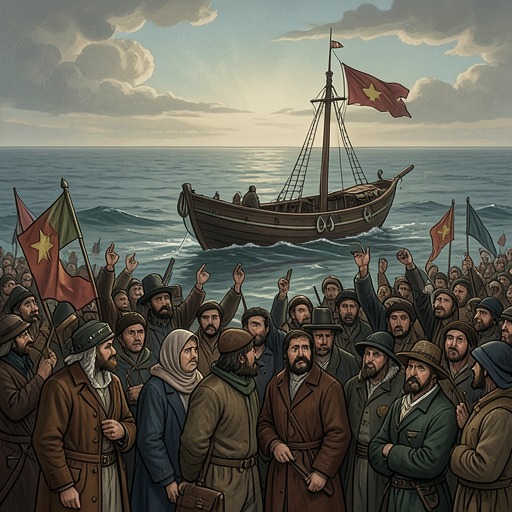
At the final approach, the group walks through the city and down to the Arabian Sea, passing from asphalt and litter onto the sand. Mishal, too weak to stand unaided, is supported by villagers. The pilgrims enter the water; none of those who go under reappears. Saeed, Osman, Srinivas, Sarpanch Muhammad Din, and Mrs. Qureishi run in after them, but the survivors are pulled back or rescued. In the account focused on Saeed’s experience, the decisive turn comes when he opens himself to Ayesha’s appeal: his body parts, she reaches within him, and the waters part. The pilgrims then walk to Makkah across the bed of the Arabian Sea. The promised destination is reached not by a plane or a boat, but through the very miracle that had made the journey seem impossible.
Narrative Significance
Makkah functions less as a described urban setting than as the pilgrimage’s distant point of orientation. Its name gathers together the villagers’ obedience, their sacrifices, the dispute between faith and skepticism, and the question of whether the sea will open. Saeed’s proposed flight would have made the destination accessible to a few by ordinary means; Ayesha’s insistence on the collective march makes the journey’s meaning depend on everyone sharing its uncertainty and danger.
The ending does not resolve that uncertainty into a simple public consensus. Most of the pilgrims disappear beneath the sea, while a handful survive and face questioning by the authorities. Yet the narrative’s final account affirms that the water parts and that the pilgrims cross toward Makkah. The city consequently remains both a sacred destination and the endpoint of a contested, extraordinary passage: the story’s focus is not a tour of Makkah, but the faith, doubt, and consequences gathered around the effort to reach it.